Saturday, September 1, 2012

Glacier Bay, Part Two


Gone fishin’!  In Hoonah, Jeff had marked places to jig for halibut on our Glacier Bay chart.  The day after our tour on the Baranof Wind (in the rain),  Greywolf took us fishing (in the rain).  Using Jeff’s pole and jig, Jolie quickly caught this little guy who agreed to be put in our freezer to become crab bait.  Not to be outdone, Bob hooked a halibut!  Excitement reigned among the novices on Greywolf. (That would be all of us).


Jolie knew something about bringing in a fish this big, so she started explaining the technique to Bob.  She knew enough to do, but not to teach, so Bob gave her the pole, and the fish surfaced.  Doug scooped him into our (challenged) salmon net.  I took pictures.   


With a length of 41 inches, the halibut weight table in Local Knowledge said he weighed 32 pounds. 


Then came the process of killing, filleting and skinning Bob's first-ever halibut.  It helped that Doug had watched the fish-killers deals with their bounty the previous Saturday.  We changed our menu for the next few days, and the rest of the halibut found a space next to the crab-bait-fish in our freezer.  


At this point, we had no more room in the freezer. We stowed Jeff’s pole and told Greywolf we were going to take her to see wolves!  The three wolves we had seen on the Baranof Wind cruise were on the same beach, doing the same thing they had been doing the previous day.  Careful observation showed that they were not dead.  A brown bear was at his station on the other side of a rock outcropping, fishing.  Are these animals under contract?  Are they union???


Puffins to port!  Critter sightings always bought everyone to attention. Two sets of binoculars for four people proved to be enough; we had no squabbles about you’ve had those long enough!


Bob spotted this brown bear on our first evening in North Sandy Cove and honed his critter-spotting skills as the week progressed. There are no black bears in Glacier Bay. He only looks black because he is a black brown bear.  Really. Some are blond brown bears.  Our Black Brown Bear was on the beach each day we were in the cove.


    I spotted this rock. ‘Looked like a bear to me.

        Bob thought it was a pig.
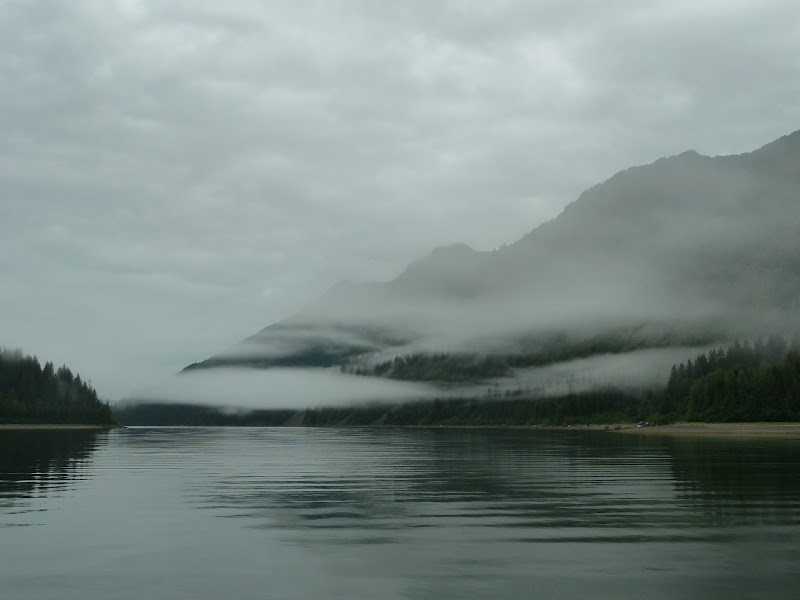


View looking north from our anchorge.
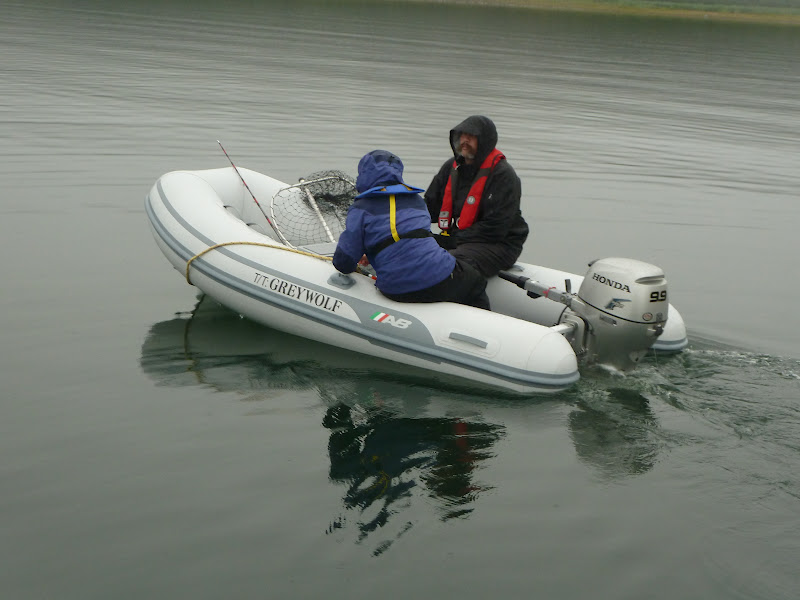
Jolie and Bob went crabbing--the only way to get away from
the old people.  They caught sea urchins, the the respite was worth it.


With three cameras and two laptops on board, we spent time downloading pictures and 
viewing the results.  Yes, I do think the table looked like that much of the time.
How do they live like that???


We celebrated Jolie and Bob’s birthdays in North Sandy Cove.  The celebrants recalled childhood Birthdays From Hell involving dogs eating birthday cakes, being attacked by swarms of hornets, and the birthday the child being left at the site of the celebration.  Why don’t we remember the Heavenly Birthdays???  


When you can’t decide what kind of cheesecake to buy, get the 
Kellogg's variety pack.


Bob is a drum major and is learning to play the pipes.  He’s explaining 
his electronic chanter to Doug.


Doug surprised himself by creating a sound that closely resembled music.  If he pursues this, 
I’ll be looking for an apartment.


We had hoped to anchor one night in front of Reid Glacier and go ashore to walk along the front of the glacier.  When we got to the bay, the entrance was was choked with berggie bits. One boat was anchored in the bay.  We would go back to North Sandy Cove, but not before An Explore.

Jolie, Bob, and I took the handheld VHF radio and puttered away in Pup to see if we could get ashore. Doug and Allie piloted Greywolf  to an ice-free spot in the channel, in the hopes that we would return.


Jolie steered Pup along a slalom course marked by small and not-so-small chunks of ice. An inflatable from the boat anchored in the bay made it’s way through the sparse ice.  Sirus, a 73 foot Nordhav’n, had anchored the night before  and was now waiting for the compacted berggie bits to move on. The crew in the inflatable was surveying an escape route.  


We could not get ashore.  Reid had created a protective moraine in front of himself...a buffer to deter tourists?  Pup bottomed out in about three feet of water; even my firefighters reluctantly admitted that was not going to work.  I called Doug on the VHF to let him know we were still afloat, and Pup headed toward the mouth of the bay.


The ice had shifted and compacted since we entered the bay. Bob positioned himself in the bow with an oar, shoving aside heavy ice chunks as we maneuvered for the shifting channels of relatively open water. The ice can be razor sharp, damaging fiberglass boat hulls.  Pup is made of fabric.  I poked at berggie bits  floating harmlessly by with the other oar, trying to appear useful.


We rounded a headland and Greywolf came into sight, waiting in relatively clear water; Pup and his crew were reunited with his big sister.  Jolie and Bob grabbed the fish net and took Pup back out to snag a small berggie bit: 200 year old ice for our rum and Cokes!

We were fortunate we navigated this Glacier Bay slushy with no heroic tales.  Bigger boats than Pup have found themselves stranded until the tide changes, as Sirus could attest.


Sirus made her way out of the ice later in the day.


We had SUNSHINE on the last day.  Jolie is reading Ordinary Wolves by Seth Kanter.  We both highly recommend it, although Jolie said ending was not what she would have wanted.


Jolie and Bob both have boat-handling experience, so we had two more helmsmen.  (I couldn’t bring myself to write “helmspeople”.)


 Little Bob couldn’t seem to get the hang of handling the wheel, so we just let him do chart work.


On our last night in the Park, we again anchored in Bartlett Cove to position ourselves for our transit to Hoonah the next day. 


Bob bought us drinks at the lodge and we enjoyed sharing impressions of Glacier Bay with other travelers.  


Sometimes you should decline when another traveler asks if you would like them to take a picture of all of you.  I’m still trying to decide what the caption should be here...


Dog prisoner, awaiting parole.

Parole granted.  


What will we take with us from Glacier Bay?  We’ll talk about the rain and the halibut and the animals and the glaciers, 
but what we’ll take with us is the spirit of this 
immense, dynamic place of land, ice and water. 


Wednesday, August 22, 2012

Glacier Bay, Part One


Correction from the last blog;  Whitehorse is NOT in British Columbia.  I know that and I apologize to everyone in the Yukon Territory and British Columbia.

I have four words to Glacier Bay National Park:  wet, magnificent,  enormous -- in that order. 

WET:  We had one sunny day out of seven.  But what can we say?  We’re in Southeast.  As one mom on the dock in Hoonah told her daughter, There is no bad weather.  Just the wrong clothing.  We had the appropriate clothing and it  all hung out (literally) in the pilot house to dry. On our tour of the Park on the Baranof Wind, Randy, the Park Naturalist, apologetically told us it was the wettest day he had seen in his six summers in the Park.  BUT it was not the worst visibility.  We could see the sides of the fiords....most of the time.


We didn’t’ see him land or take off.  He was just sitting there in the rain and berggie bits.

Ghost ship.


Are we cold?  Not so much.  Wet?  You bethca’


MAGNIFICENT:  We visited five glaciers and saw others carving their way down their mountains.   We saw ice bergs and a glacier calving.  We saw moose and seals and sea lions and birds and bears and wolves(!) and whales.  We saw clouds protecting the mountains and then parting into wispy strands to show us rocks and snow-covered peaks and myriad shades of green and gray.  We saw brown glacier-melt water and bright Caribbean-blue water. 


Margerie Glacier was the first glacier we visited, and, I thought, the most impressive: tall (250 feet above sea level, 50-100 feet below) and pretty.   And she is stable, neither receding  or advancing.  I think she knew we were watching, ohhing and ahhing when she calved and silently taking in her colors and contours.  


Grand Pacific Glacier, adjacent to Margerie.  His face is very dirty; at first, I thought he was a huge bank of dirt.   He is the biggest glacier we visited:  2 miles wide and 35 miles long.  And he has dual citizenship. The face is only a few miles (25?) inside the US boarder. Someday he will be a Canadian Citizen (BC). Yes, there will be a quiz at the end of the blog.  Open computer.


Lamplugh Glacier, our third glacier on the Baranof Wind tour.  Each glacier does have it’s own personality.  I like Lamplugh’s cave and wondered how long it will be before it’s ceiling becomes berggie bits..


ENORMOUS:   Although we traveled each day, we only covered a fraction of the Park.  Twenty-five pleasure boats are allowed in the Park at a time; we rarely saw any of them.  I was glad we had company on Greywolf.  In the Inside Passage, we have gone for days without seeing another boat, and certainly being the only boat is an anchorage is not unusual, but Glacier Bay FELT big.  

We talked with several cruisers who always take their Glacier Bay guests on a tour of the Park on the Baranof Wind.  Since the Park is so large, the tour gives a good overview in a short (eight hour) period of time.  We knew that the tour boat could get closer to the glaciers through the berggie bits and would certainly exceed Greywolf’s leisurely pace.  We signed up.


Baranof Wind note:  Approaching Ketchikan three weeks later, I was talking on the phone with my sister and mentioned that one of the smaller (700 feet) cruse ships, the Vonderdam, ahead of us was not getting any respect in Tongas Narrows and was on the VHF radio for the third time to ask another vessel what its intentions were.

Are you planning to continue to cross in front of me?
That’s my plan.
Then I suggest you speed up.

Good idea.

Oh!  Joani said.  That’s the boat that transferred the passengers off a tour boat in Glacier Bay.

It seems Captain Bob was trying to get close to shore to give the passengers a good view of a brown bear.  Bummer.  Those skippers are under pressure to give the customers a good experience.  

Numbers to validate ENORMOUS:  Glacier Bay National Park and Preserve’s 3.3 million acres is part of a 24 million acre UNESCO designated World Heritage Site, one of the largest protected natural areas in the world.  Looking at a map of the Heritage Site, you can see that it includes Canadian and US territory.  You can also see a little white clump of land boarding the Gulf that is not part of the Heritage Site.  A Wall-Mart?  Who held out, refusing to ceed control to UNESCO?  The Tongas National Forest. Really?  They couldn’t spare that chunk of land? Maybe there is more to the story.


The Park staff has a strict protocol for visiting boaters.  You contact the Park on the VHF radio before crossing the boundary. You stay one mile off shore (whale protection) near the entrance.  You proceed at less than 13 knots (why 13 and not 12 or 14???) in Bartlett Cove.  You make a 90 degree turn to the Park dock.  You then attend an orientation session where you are informed about the other Park rules.  Everything is designed to keep the impact on the wildlife at  minimum.  The off-limits areas are constantly being revised as animal populations move.

As soon as we tied up at Bartlett Cove, the only dock in the Park, Allie launched herself off the boat as she always does, and landed in the water between the boat and the dock.  I didn’t realize that I had her retractable leash in the lock position and had only given her enough rope to hang herself.  Knut, the skipper of a Salty Dawg, a Nordic Tug we had met in Hoonah, had taken our lines as we tied up.  He now took our dog’s harness and hauled her out.  She was so excited to be be on a dock, we didn’t even bother to dry her off.  She attended the orientation session, totally approving of the brand of dog treats offered.  She didn’t know that Bartlett Cove would be her last opportunity to touch land for a week.  Dogs are not allowed on shore in other parts of the Park.

Jolie and Bob’s Alaska Airlines plane landed at Gustavus, ten miles away and they stepped out of the taxi in Summer Clothing.  
Seattle: 2:30 PM, 95 degrees.  Sun. 
Gustavus, 4:40 PM 55 degrees. Rain.  


Luggage and backpacks spewed out their contents which were stowed in the guest stateroom A.K.A. walk-in closet.  


Vessels can only stay at the Bartlett Cove dock for three hours; Greywolf found herself a comfy spot to anchor.  


We then went through a circus of launching Pup.  Having our daughter on board apparently reminded us of how old we are.  We couldn’t get the correct lines loosened and made off.  As these two old people stared up into the rain at the lines, booms, mast, and electric motors saying, “How have we done this in the past???”, I know that Jolie was ready to have the Coast Guard confiscate the boat and put us in The Home.


Monday morning we donned rain gear and life jackets and piled into Pup, headed for the Baranof Wind  AND our free souvenir mug!


Our Naturalist, Randy, had wonderful information about the Park and the animals.  I wish I could remember it...  

This covers our first day.  I thought I’d get the entire adventure in this blog, but since I have difficulty being concise and since we have to leave at oh’dark hundred for Grenville Channel (We’re in Prince Rupert, BRITISH COLUMBIA.), I’m going to send the second installment when we next have internet.